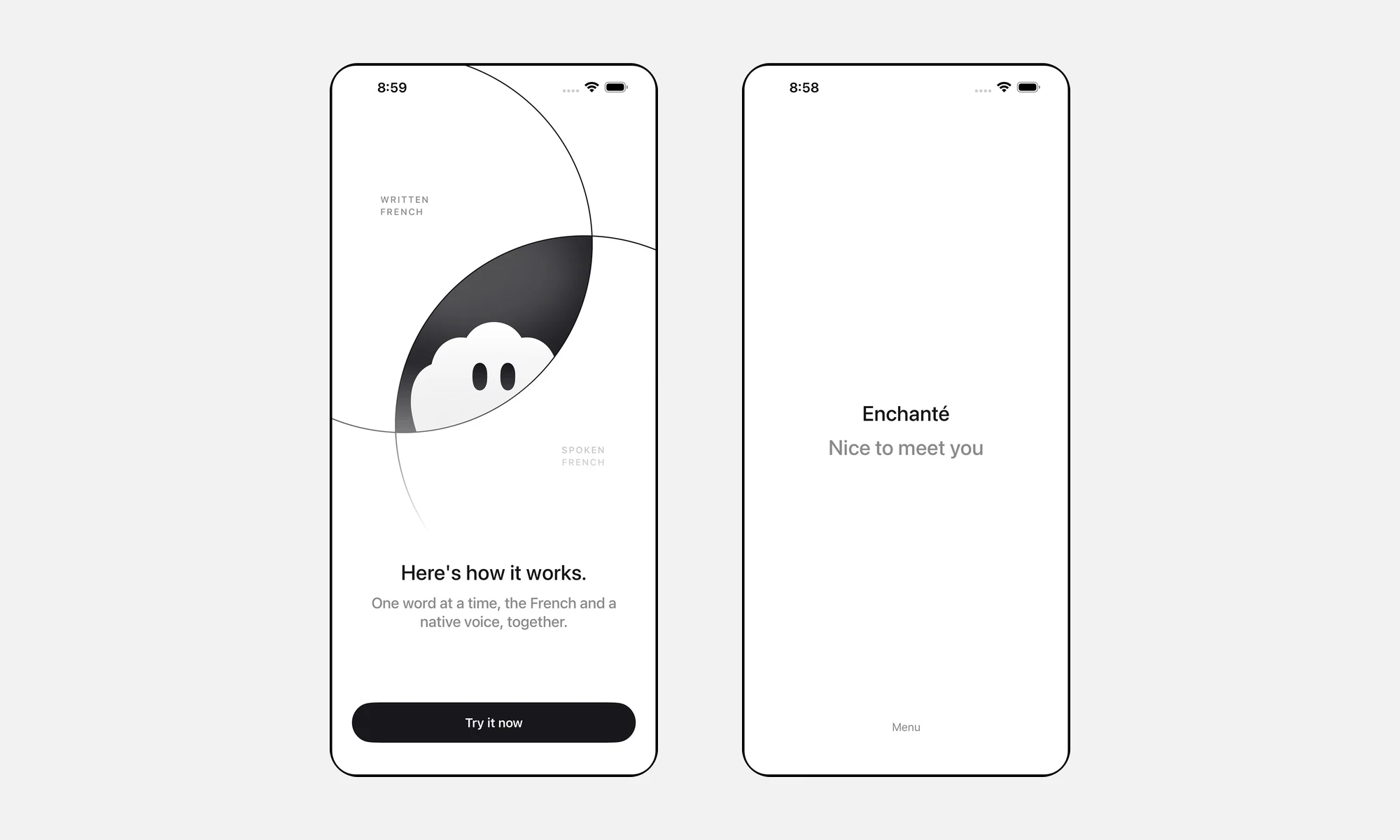
When we announced our shift to a venture studio in January, Madeleine was the one still marked “coming soon.” It has been on the App Store since June 18 — our first consumer app, and the first product we've taken from idea to shipped entirely in-house.
Madeleine teaches French vocabulary on the iPhone. That's the whole product. One language, one course: about 1,300 of the most useful French words and everyday phrases, ordered by how often you'll actually hear them rather than by textbook chapter. The course is finite. You can finish it.
Every card pairs the written word with audio recorded by native French speakers — you pick a companion voice from four — so your ear trains alongside your eyes from day one. You press and hold to check yourself, and the app quietly works out how well you knew the word from how you answered. There's no grading yourself on a scale. Underneath, a spaced-repetition engine stretches solid words further apart and brings shaky ones back sooner.
Honestly, most of the design work went into what Madeleine doesn't do. There are no streaks, points or leaderboards, and no daily goal to fall behind on — a session ends on its own, and nothing punishes you for skipping a day. There are no grammar drills; grammar and conversation are what tutors, classes and time in France are for, and Madeleine's job is to make those hours go further. There's no account and no server — your progress lives on your phone.
It's a paid app: $9.99 a month or $49.99 a year, with no free tier. We'd rather earn the subscription than design around advertising. Aesso designed and built it — SwiftUI throughout, Apple frameworks only, no third-party dependencies. It runs on iOS 26 and later.
We built Madeleine because the alternatives were either ugly or overcomplicated, usually both. We wanted the app we'd actually use. Now it exists.